
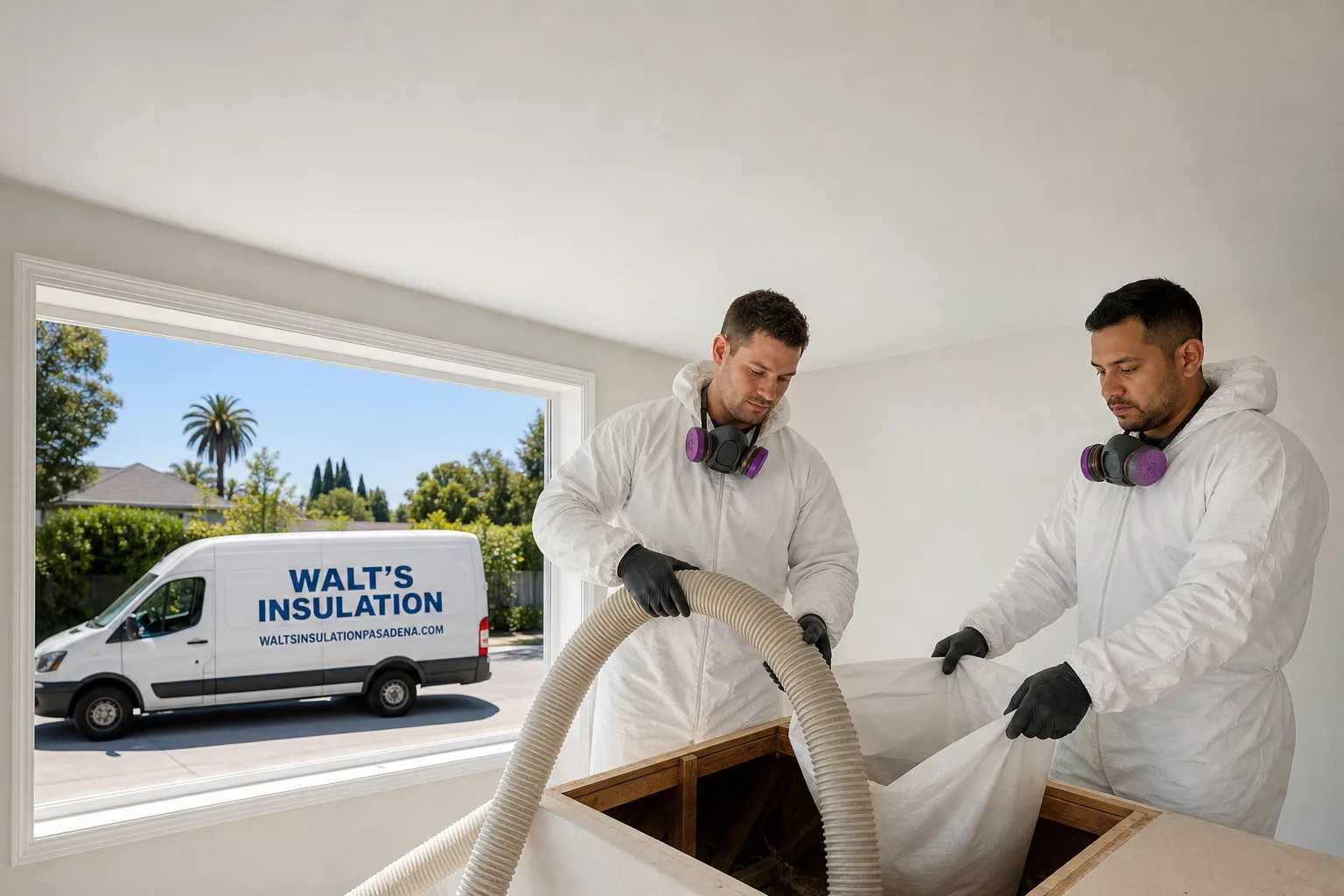
Fast, Reliable Attic Insulation Across Whittier
Most Whittier homes need more attic insulation than they have. We see it every week: a 1920s Craftsman off Greenleaf Avenue with empty wall cavities, a mid-century ranch in the flats with three inches of compressed fiberglass, a Friendly Hills hillside custom with an attic so shallow you have to crawl on your belly to reach the far corner. Walt’s Insulation has been correcting these exact problems since 2000. Our crews know Whittier’s housing stock block by block, and we answer the phone live, 24/7. If you’re tired of a second floor that won’t cool below 80 on a 100-degree August afternoon, call (626) 606-2964 for a free estimate and a straight answer about what’s actually going on up there.
Why Walt’s Insulation Is Whittier’s Preferred Attic Insulation Company
Whittier homeowners tend to ask harder questions than most, and we like that. They want to know who’s walking into their house, whether the crew understands old plaster walls, and whether the work will hold up through a Santa Ana season. The answers are simple. Our technicians are background-checked, uniformed, and trained on the specific failure patterns we find in Whittier’s pre-war and mid-century homes. Walk-up attic access, shallow roof pitches, knob-and-tube wiring remnants, original plaster ceilings that crack if you stomp around up there: these are not surprises to us. They’re Tuesday.
We’re locally owned and owner-operated. Walt Brenner started this company in 2000, and his name is still on the door, the license, and the guarantee. That guarantee is the Done Right Promise: if it’s not done right, we make it right. No runaround, no ghosting, no “that’s not covered.” And because Whittier is inside our service county, there’s no trip charge when we come out to assess your attic. Every call is answered by a live person, 24/7, not a voicemail tree. That matters when you’re trying to schedule around a hot spell or you need someone to look at a ridge vent that just started rattling in the wind.
Our Attic Insulation Services in Whittier
Blown-In Attic Insulation
Blown-in fiberglass or cellulose is the workhorse for Whittier attics, especially in the post-war tracts and mid-century homes where access is tight and existing insulation is thin. We typically blow Owens Corning PROPINK or Johns Manville fiberglass to R-38 across the attic floor, working around trusses, duct runs, and electrical boxes. For the plaster-on-lath bungalows near Uptown, blown-in insulation goes in across the attic floor while we address the bigger heat-transfer problem separately, which we’ll get to below. A full blow-in in a typical 1,200-square-foot attic in Whittier runs $1,800 to $3,200 depending on depth and prep work.
Attic Batt Insulation
Batt insulation works best in Whittier homes with open, regular rafter spacing and no obstructions, or as a targeted layer over problem spots. We install Knauf and Rockwool batts where blown-in isn’t practical, like shallow attic edges or sections above vaulted ceilings. Rockwool also gives Whittier homeowners something extra: it’s dense enough to reduce sound transfer, which matters on streets like Mar Vista where traffic noise from Whittier Boulevard carries up into second-story bedrooms. Batt work in Whittier typically runs $1,500 to $2,800 for a standard attic.
Attic Insulation Top-Up
Many Whittier attics don’t need a full replacement. They need a top-up: adding fresh blown-in insulation over existing material to bring the depth up to code. If your attic has two to four inches of old fiberglass, which is what we find in most mid-century tract homes here, a top-up gets you to R-38 or beyond without the cost of removal. Top-ups generally run $900 to $1,800 in Whittier. We also flag any issues we see while we’re up there: rodent droppings, dead vent fans, disconnected ductwork, water staining from a slow roof leak. You get the full picture before we add material.
Attic Insulation Replacement
Replacement means removing what’s there and starting fresh. Whittier homes with rodent damage, water intrusion from Santa Ana-driven rain, or insulation that’s been matted down by decades of dust and foot traffic need this route. We use high-powered vacuums to pull out the old material, sanitize the attic floor, air-seal, and blow in new insulation. Replacement in Whittier runs $2,800 to $5,500 depending on attic size and condition. We’ll give you a firm, written estimate before any work begins, and the Done Right Promise applies to every job.
Attic Baffles & Ventilation Prep
This is the step that separates a real Whittier insulation job from a quick blow-and-go. Baffles keep soffit vents open so air can move from the eaves up to the ridge. Without them, blown-in insulation blocks the airflow and your attic becomes a sealed oven. In Whittier, where Santa Ana winds shove dust and debris into attic spaces every fall, proper baffles and ventilation prep are the difference between insulation that works for twenty years and insulation that mats down in five. We install baffles on every blown-in job where soffit vents exist, and we’ll tell you honestly if your ventilation needs work first.
What happens when you call
- 1
A real person answersNo phone trees - you reach a local pro.
- 2
You get an upfront price rangeHonest numbers before anyone is dispatched.
- 3
A background-checked tech heads outLicensed & insured, dispatched right away.
- 4
You approve before work beginsNothing starts until you say go.
Trusted Brands We Service in Whittier
We install insulation from manufacturers we’ve trusted for years: Owens Corning, Johns Manville, Knauf, and Rockwool among them. These are not mystery materials from a warehouse we’ve never visited. We know how they behave in Whittier’s heat, how they settle over time, and how they hold up to seasonal dust and wind. Our Attic Insulation team stocks common materials and equipment locally for fast turnaround, which means we don’t have to put off a Whittier job because a pallet hasn’t arrived from out of state. When you call with a question about what’s going into your attic, the person on the phone knows the product, not just a model number.
Common Attic Insulation Problems We See in Whittier Homes
- Plaster-on-lath walls with empty cavities in Uptown’s historic bungalows. Insulating the attic floor helps, but heat still moves through uninsulated walls, which is why we talk to these homeowners about dense-pack options alongside attic work. No one else in the eastern San Gabriel Valley sees this combination as often as we do.
- Shallow, poorly ventilated attics in Friendly Hills custom homes. Trapped radiant heat bakes shingles from underneath and forces AC systems to run constantly. We find less than R-11 in most of these attics, and the fix is air-sealing, ventilation correction, and proper blown-in depth: not just more fiberglass dumped on top.
- Santa Ana wind-washing in fall. Seasonal gusts push dust and airborne debris through attic vents, which settles into blown-in insulation and reduces its effective R-value within a few seasons. Proper baffles and filter media are the only real defense.
- Compressed, degraded fiberglass in post-war tract homes. The 1950s and 60s ranches across the Whittier flats were built to code at the time, which meant two to three inches of fiberglass: nowhere near what Title 24 requires now. Most of that original material is flat, dusty, and barely insulating.
Pricing for Attic Insulation in Whittier, CA
We Also Serve Cities Near Whittier
Our crews work throughout the eastern San Gabriel Valley, so if you’re in Rosemead, La Puente, Temple City, or Alhambra, we can usually reach you the same week. Many of those neighborhoods share the same housing era and attic problems we see across Whittier, which means we arrive already knowing what’s likely up there. Call for a free estimate and we’ll confirm what’s what.
Serving Whittier, CA - Our Local Coverage Area
We’re based in the Whittier area and know this community well. Use the map below to see our service coverage - if you’re nearby, we can almost certainly help.
FAQs - Attic Insulation in Whittier
How does attic insulation help with the heat that builds up in Whittier’s historic plaster-walled bungalows?
Attic insulation reduces heat gain from above, but in Whittier’s pre-war bungalows near Uptown, the plaster-on-lath walls are also uninsulated, so they transfer heat sideways into living spaces. The most effective approach for these homes is a combination: blown-in attic insulation to R-38 or higher, plus dense-pack cellulose or injection foam in the wall cavities where feasible. Attic work alone will help, but it won’t fully solve a wall-heat problem on a 100-degree day. Call (626) 606-2964 and we’ll walk your specific house before recommending anything.
What is the typical R-value found in Whittier’s mid-century Friendly Hills attics, and what is needed today?
Most Friendly Hills mid-century homes we inspect have R-8 to R-11 in the attic: about three to four inches of compressed, degraded fiberglass. Current Title 24 standards call for R-38 or better in Southern California climates. The fix is either a substantial top-up or a full replacement, along with air-sealing and ventilation correction. Every Friendly Hills job should be treated as a full-system fix, not a quick add. Call us for a free attic inspection and we’ll tell you exactly what yours has.
Do attic insulation jobs in Whittier need to account for Santa Ana winds?
Yes. Santa Ana winds push dust and debris through attic vents each fall, which settles into blown-in insulation and mats it down, lowering its effective R-value. Proper baffles, clean vent openings, and sometimes filter media at the vent intakes are the only way to keep blown-in insulation performing for more than a few seasons. We build for this reality on every Whittier job. Call (626) 606-2964 and we’ll explain what your attic needs for the wind season.
Why is air-sealing often recommended along with blown-in attic insulation in Whittier’s older homes?
Older Whittier homes have gaps around top plates, plumbing penetrations, and electrical boxes that let conditioned air escape into the attic all year. Blowing insulation over unsealed gaps is like putting a blanket over a cracked window: it helps, but the air still moves. Air-sealing closes those leaks first, so the insulation can do its actual job. We include air-sealing as a standard recommendation on most Whittier attics, not an add-on we push if the budget allows.
How does the trapped attic heat in Whittier affect roof shingles, and can insulation help?
Attics that bake at 140°F in Whittier’s summer heat cook shingles from underneath, making them brittle and shortening the roof’s life. Insulation alone doesn’t solve this: proper ventilation and a radiant barrier are what actually lower attic temperature. Insulation protects the living space from that heat; ventilation and radiant barrier protect the roof. In Whittier’s inland climate, all three need to work together. Call (626) 606-2964 for a free attic assessment and we’ll show you what’s happening up there.
Call Walt’s Insulation for Attic Insulation in Whittier
If your Whittier home is hot in summer, cold in winter, or just harder to keep comfortable than it used to be, start with the attic. Walt’s Insulation has served the eastern San Gabriel Valley since 2000, and we’ve seen every attic failure pattern Whittier can throw at a house. The one down the road: that’s us. A live person answers every call, 24/7. No voicemail, no answering service, no callback tomorrow. Call (626) 606-2964 today for a free estimate. We’ll come out, look at your attic, tell you what it needs and what it doesn’t, and stand behind every recommendation with the Done Right Promise. If it’s not done right, we make it right. That’s been the deal since day one, and it’s not changing.
Written by Walt Brenner, Owner at Walt’s Insulation, serving Whittier and the eastern San Gabriel Valley since 2000.