
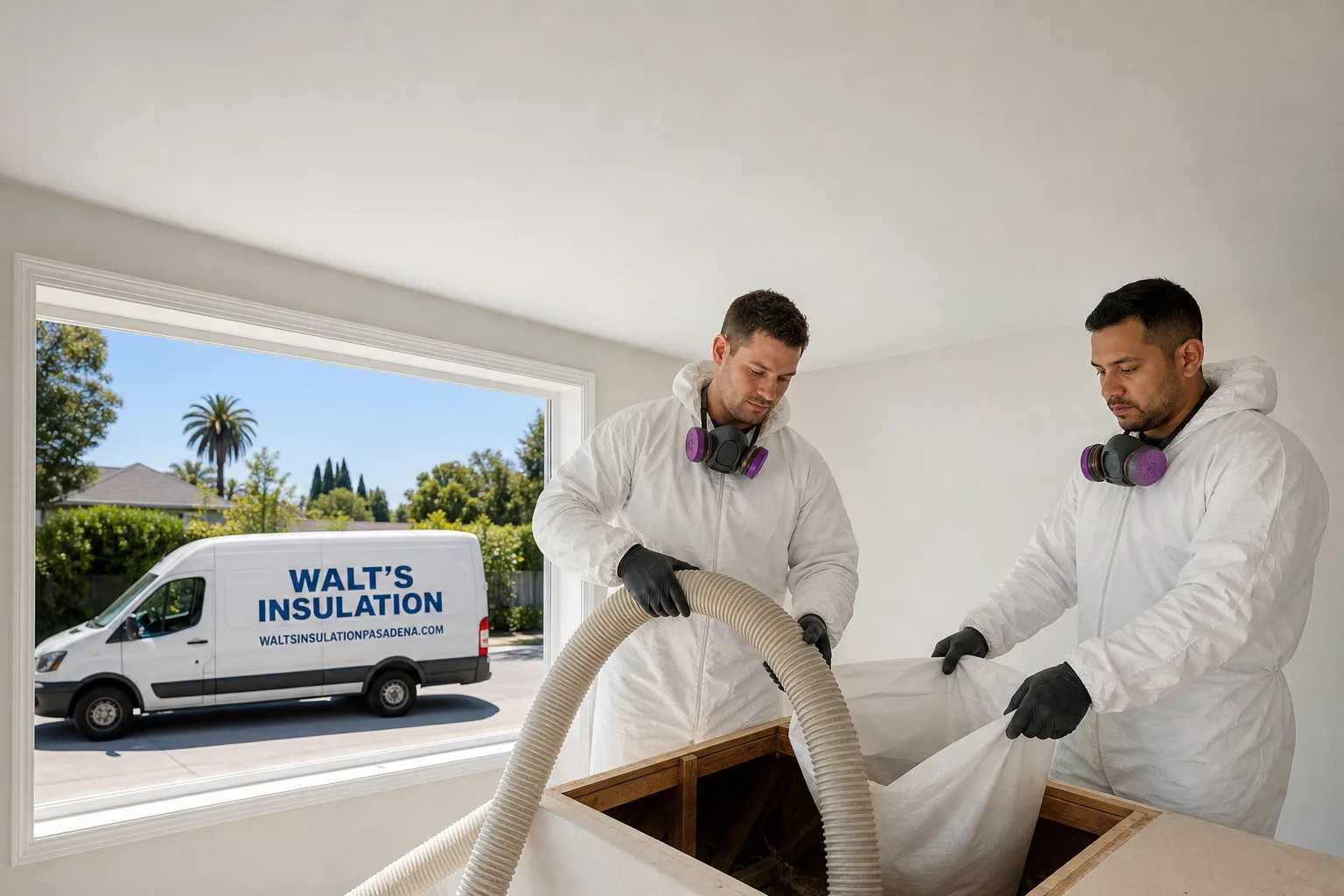
How Much Does Wall Insulation Cost in Pasadena?
Our Wall Insulation services in Pasadena, CA typically cost between $1.50 and $4.50 per square foot, depending on the insulation type, wall access method, and the size of your home. Most Pasadena homeowners spend between $1,800 and $5,500 for a full exterior wall insulation project on an average single-story house. Same-day estimates are available – call (626) 606-2964) and a real person will pick up, any time of day.
Wall Insulation Cost Breakdown (2026)
Below are the real price ranges we see in the Pasadena market right now. These reflect actual project costs – material, labor, and standard access – not stripped-down quotes that balloon at invoice time.
| Insulation Type | Cost Per Sq Ft (Installed) | Typical Project Cost | Best For |
|---|---|---|---|
| Blown-In Fiberglass (Existing Walls) | $1.50 – $2.50 | $1,800 – $3,200 | Retrofit, closed walls, minimal disruption |
| Blown-In Cellulose (Existing Walls) | $1.40 – $2.20 | $1,700 – $2,900 | Retrofit, eco-conscious homeowners |
| Batt Insulation – Fiberglass (Open Walls) | $1.20 – $2.00 | $1,400 – $2,600 | New construction or gut remodels |
| Batt Insulation – Rockwool/Mineral Wool | $1.80 – $2.80 | $2,100 – $3,600 | Fire resistance, soundproofing, older homes |
| Open-Cell Spray Foam (Open Walls) | $1.80 – $3.00 | $2,200 – $4,000 | Air sealing + insulation in one step |
| Closed-Cell Spray Foam (Open Walls) | $3.00 – $4.50 | $3,600 – $5,500+ | Maximum R-value, moisture barrier, small spaces |
| Dense-Pack Cellulose (Existing Walls) | $1.60 – $2.60 | $1,900 – $3,400 | Retrofit into older wood-frame homes |
A few things to note about how these numbers land in Pasadena specifically. Homes built before 1980 – and there are a lot of them in the historic neighborhoods around Bungalow Heaven, Chapman Woods, and Madison Heights – often have 2×4 framing with little to no insulation at all. Adding blown-in or dense-pack insulation to those walls without opening them up is the most common project we handle here. Homes built from the 1980s through the early 2000s might have some fiberglass batts already in the walls, but thin, improperly installed, or degraded batts are surprisingly common, especially in homes that have had multiple owners.
Labor costs in the Pasadena area are on the higher end of the Southern California range – expect that to be reflected in quotes you get from any licensed, properly insured contractor. Crews charging significantly less are usually cutting something, whether that’s insurance coverage, permits where required, or the quality of the material itself.
What Affects Wall Insulation Pricing in Pasadena
- Access method – open vs. closed walls: Open walls during a remodel are the most cost-efficient because there’s no drilling and patching required. Retrofit jobs on closed walls require drilling small holes between studs, blowing in the material, and patching the exterior or interior surface afterward – that adds labor time and material cost. In Pasadena, most retrofit jobs involve stucco exteriors, which require careful patching to keep a clean finish.
- Insulation type and R-value target: Pasadena sits in IECC Climate Zone 3, and California’s Title 24 energy code sets minimum R-value requirements for walls in new construction and permitted remodels. Closed-cell spray foam from brands like Icynene or Demilec can hit R-6 to R-7 per inch, meaning you can achieve code minimums in a thinner cavity than fiberglass batts. Higher-performance products cost more per square foot, but you get more performance per inch of wall depth.
- Home size and number of exterior walls: A small 1,200 sq ft craftsman bungalow in Bungalow Heaven has far fewer linear feet of exterior wall than a 2,500 sq ft two-story in San Rafael Hills. Larger homes cost more in total but can benefit from lower per-square-foot pricing once a crew is already set up and working.
- Existing insulation condition: If there’s old, compressed, or damaged insulation already in the wall cavities, it may need to be removed first before new material goes in. Removal adds to the cost, but leaving bad insulation in place and blowing new material over it rarely produces good results.
- Wall construction and framing: Some older Pasadena homes – particularly Craftsman-era properties built in the early 1900s – have non-standard framing, plaster walls instead of drywall, or irregular stud spacing. These conditions take more time to work around and affect the final price. Homes with true exterior masonry or solid adobe-style walls may not be candidates for retrofit blown-in at all.
- Permit requirements: Pasadena’s Building and Safety Division requires permits for certain insulation work, particularly when it’s part of a larger remodel or when spray foam is being applied. Permitted work costs more upfront but protects you when you sell the home – unpermitted insulation work can stall escrow and create headaches. We pull permits where required, every time.
How to Save on Wall Insulation in Pasadena
The biggest savings opportunity most homeowners overlook is timing the project with other work. If you’re already opening walls for a bathroom remodel, kitchen update, or electrical panel upgrade, adding batt insulation from Owens Corning or Johns Manville at that point costs a fraction of what a standalone retrofit project runs. Talk to your contractor before the walls close – it’s a small conversation that can save you significant money.
On standalone retrofit jobs, blown-in cellulose from a brand like GreenFiber is often the most cost-effective path for Pasadena homes with stucco exteriors. It’s dense enough to fill irregular cavities, it settles very little over time, and it doesn’t require opening the walls beyond small drill holes. GreenFiber and similar cellulose products also have strong recycled content, which matters to a lot of homeowners in this area.
Utility rebates are real money here. SoCalGas and Southern California Edison both offer rebates for insulation upgrades that meet efficiency thresholds, and the federal 25C tax credit allows you to claim up to 30% of insulation costs, capped at $1,200, on your federal tax return for qualifying projects. Those programs have deadlines and eligibility rules that change, so check with your tax professional and with the utilities directly – but don’t leave that money on the table.
A few practical ways to keep your project cost in check:
- Get a free second opinion on any written estimate – Walt’s offers this as a standing policy, no strings attached. If another contractor has quoted you, we’ll review it and tell you honestly whether it’s fair or where you might be overpaying.
- Bundle wall insulation with attic insulation if both need attention. Mobilizing a crew once for two projects saves on setup and travel time compared to scheduling them separately.
- Ask about the $40 off any repair or service over $200. If your project includes any remediation or prep work, that discount applies.
- Seniors and veterans get a permanent 10% discount at Walt’s – always. No expiration date, no fine print.
- There’s no trip charge for homes inside our service county, so calling for a free estimate costs you nothing.
To get an accurate number for your specific home, call (626) 606-2964. We’ll send someone out, look at what’s actually in your walls, and give you a written estimate with no pressure to sign the same day.
Pasadena Wall Insulation: What We See on the Ground
We’ve been doing wall insulation in Pasadena long enough to have a clear picture of what’s common in different parts of the city. In the historic districts around Bungalow Heaven and Prospect Park, homes from the 1910s through the 1930s were built with virtually no wall insulation – it simply wasn’t standard practice then. The walls are often narrow, the framing is irregular, and blown-in cellulose or fiberglass is almost always the right answer because it fills those cavities without requiring demolition.
In the neighborhoods east of Lake Avenue, particularly in Hastings Ranch and the areas near Sierra Madre Villa, we see a lot of tract homes from the 1950s and 1960s. These homes sometimes have original fiberglass batts, but after 60-plus years those batts are compressed, dusty, and delivering a fraction of their original R-value. In many of those cases, we’re recommending removal and replacement rather than topping off, because layering new material over old degraded batts doesn’t accomplish much.
In newer construction along the northern edges of Pasadena closer to the foothills – neighborhoods like Annandale and Linda Vista – homes from the 1990s and 2000s are more likely to already have decent wall insulation. But we regularly find air leakage problems even in those homes: insulation is present but gaps around outlets, penetrations, and corners let conditioned air out and hot air in. That’s where combining wall insulation with a full home energy assessment makes a real difference.
Pasadena summers are genuinely hot. When temperatures in the Arroyo Seco area push into the high 90s and the Santa Ana winds push that further, an under-insulated wall isn’t just an energy bill problem – it makes parts of the house uncomfortable regardless of how hard the AC runs. We hear that complaint constantly from homeowners in east Pasadena, particularly in upper-floor rooms where radiant heat from walls adds to the ceiling effect. Addressing wall insulation in combination with a radiant barrier in the attic is often what finally solves it.
Insulation Materials: What We Install in Pasadena Walls
We work with materials from manufacturers we trust and have used for years – not whatever’s cheapest this month. For wall applications specifically, here’s what we install and why:
Owens Corning and Johns Manville Fiberglass Batts
These are the go-to for open-wall applications during new construction or remodels. They’re cost-effective, widely available, and when they’re cut and installed correctly – without compression, gaps, or voids – they perform well. The keyword is correctly. A compressed fiberglass batt in a 2×4 wall can drop from R-13 to R-9 or less. We cut them to fit.
Rockwool (Mineral Wool) Batts
Rockwool has become a serious option for Pasadena homeowners in the last several years, and for good reason. It’s naturally fire-resistant to over 1,200 degrees Fahrenheit, which matters in a region with documented wildfire risk. It’s also denser than fiberglass, which means better soundproofing – useful if you’re insulating an interior wall between rooms or adjacent to a street-facing exterior. It costs more per batt, but the performance difference in noise and fire resistance is real.
GreenFiber and Dense-Pack Cellulose
For retrofit jobs where we’re not opening the walls, dense-pack cellulose is our most common recommendation. It’s blown in at high density so it doesn’t settle, it fills irregular cavities better than fiberglass, and the thermal and air-resistance performance is strong. GreenFiber specifically has a consistent product that our crews have worked with for years.
Icynene and Demilec Spray Foam
Spray foam is the right answer in specific situations: walls with significant air leakage problems, small areas where access is limited, or where you need the highest possible R-value in a thin cavity. Open-cell foam from Icynene expands to fill every gap and works well for air sealing. Closed-cell from Demilec provides a vapor barrier in addition to thermal resistance, which can matter in homes with moisture issues. Spray foam is not always the right call for a whole-house wall project – the cost-to-benefit ratio often favors blown-in cellulose for large exterior wall areas – but for targeted applications it’s the best tool available.
CertainTeed and Knauf Products
CertainTeed’s fiberglass batt line and Knauf’s EcoBatt (made with a formaldehyde-free binder) are solid options for homeowners with sensitivities to off-gassing or who are specifically looking for low-VOC materials. We stock and install both.
DIY vs. Professional Wall Insulation in Pasadena
If you’re doing an open-wall project during a remodel and you’re comfortable cutting and fitting fiberglass batts, that’s a legitimate DIY task for an experienced homeowner. Wear an N95 mask, safety glasses, and long sleeves – fiberglass irritates skin and airways, and you don’t want to find that out the hard way.
Retrofit blown-in and spray foam are a different matter. Blown-in into closed walls requires proper equipment, the right nozzle pressure, and experience reading wall cavities to know when they’re full. Under-fill leaves cold spots; over-pressure can blow out drywall seams. And spray foam – particularly two-component closed-cell systems – involves chemical reactions that require professional training and protective gear. Getting the mix ratio wrong produces off-gassing, structural problems, or foam that doesn’t cure properly. We’d rather tell you that plainly than watch someone try it from a YouTube tutorial.
For permits: any insulation work that’s part of a permitted remodel in Pasadena requires that insulation meet Title 24 standards. If you’re doing unpermitted DIY work that later surfaces during a sale or refinance inspection, it can create real problems. We pull permits on every job that requires them.
FAQs – Wall Insulation Cost in Pasadena
How much does wall insulation cost per square foot in Pasadena?
Installed wall insulation in Pasadena costs between $1.40 and $4.50 per square foot, depending on the material. Blown-in cellulose runs $1.40 to $2.20 per square foot; fiberglass batts in open walls run $1.20 to $2.00; closed-cell spray foam runs $3.00 to $4.50. The range is wide because the right product depends on whether your walls are open or closed and what performance you’re targeting. Call (626) 606-2964 for a free, written estimate based on your actual home.
Is it worth insulating existing walls in an older Pasadena home?
Yes – in most cases, it’s one of the highest-return energy upgrades available. Older homes in Pasadena’s historic districts routinely have zero wall insulation, meaning exterior walls are the primary path for heat to enter in summer and escape in winter. Retrofit blown-in insulation on a 1,500 sq ft home typically costs $2,000 to $3,500 and can reduce heating and cooling loads noticeably. Combined with utility rebates and the federal 25C tax credit, the payback period is often under seven years. The comfort difference is immediate.
How long does wall insulation installation take?
A typical retrofit project on a single-story Pasadena home – say 1,200 to 1,500 sq ft of exterior wall area – takes one to two days, including drilling, blowing in material, and patching. Open-wall batt installation during a remodel goes faster. Spray foam projects vary by scope but are usually completed in a single day for wall sections. We’ll give you a specific timeline when we assess the home.
Will wall insulation reduce my electricity bill in Pasadena?
It typically does, though the exact reduction depends on your current insulation level, your HVAC system, and how well the rest of the house is sealed. Homes starting with no wall insulation see the biggest gains – we’ve seen customers in east Pasadena report 15 to 25 percent reductions in summer cooling costs after a full wall insulation project. Homes with existing (but degraded) insulation tend to see smaller improvements. A home energy assessment before you insulate can help you understand exactly where the losses are and where your money will do the most work.
Does Walt’s Insulation offer financing or discounts for wall insulation projects?
We offer a permanent 10% discount for seniors and veterans – no expiration, no application required, just tell us when you call. There’s also $40 off any project over $200, and no trip charge for homes in our service county. If you have a written estimate from another contractor, we’ll give you a free second opinion on it – no cost, no obligation. Call (626) 606-2964) to get started or to ask about current financing options.
Why Pasadena Homeowners Call Walt’s
Walt Brenner started this company in 2000 with a published address and a real license number – not an 800 number that routes to a call center two states away. Walt’s Insulation has been insulating homes in Pasadena and the surrounding communities for over 25 years, and the business is still owner-operated. That means when something isn’t done right, there’s a real person accountable for fixing it – and the Done Right Promise makes that official. If the work isn’t right, we come back and make it right. No runaround, no fine print.
Every technician who comes to your home is background-checked and uniformed. You’ll know who’s walking in before they arrive. And when you call – at 7 AM, at 10 PM, any time – a live person picks up. Not a voicemail, not an answering service. That matters when you’re trying to schedule a project or get a quick answer about whether a quote you received makes sense.
We install materials from manufacturers we know and trust: Owens Corning, Rockwool, Icynene, Johns Manville, CertainTeed, Demilec, Knauf, and GreenFiber. We don’t substitute cheaper off-brand products without telling you, and we don’t recommend a more expensive product just because the margin is better. The recommendation fits the house.
If you’re comparing quotes and want a straight answer about whether what you’ve been told is reasonable, call us. The second opinion is free, and there’s no pressure on the other end of that call.
Key Takeaways
- Wall insulation in Pasadena costs $1.40 to $4.50 per square foot installed, with most whole-home projects running $1,800 to $5,500.
- Retrofit blown-in (cellulose or fiberglass) is the most common and cost-effective method for Pasadena’s older closed-wall homes.
- Rockwool batts are worth considering for fire resistance and soundproofing, particularly in homes near wildfire-risk areas or busy streets.
- California’s Title 24 and federal 25C tax credit (up to 30%, capped at $1,200) can significantly offset project costs.
- Stucco exteriors, older framing, and historic construction in neighborhoods like Bungalow Heaven and Madison Heights affect project scope and pricing.
- Seniors and veterans always get 10% off. No trip charge inside the service county. Free second opinion on any written estimate.
- All work is backed by the Done Right Promise – lifetime workmanship, no runaround.
Get a Free Estimate for Wall Insulation in Pasadena
If you’re trying to figure out whether your walls need insulation, what type makes sense for your home, or whether a quote you’ve already received is reasonable, call (626) 606-2964. A real person will pick up – any time, any day. Walt’s Insulation has been doing this work in Pasadena since 2000, and we’re not going anywhere. Free estimates, upfront pricing, no trip charge in the county. That’s the short version. Call us and we’ll give you the longer one.
Pricing reflects the Pasadena market as of 2026. Walt’s Insulation offers free estimates – call (626) 606-2964.
Written by Walt Brenner, Owner at Walt’s Insulation, serving Pasadena, CA since 2000.
What Our Customers Say
"Crawl space was wet every spring. They laid the heavy liner, sealed the vents, and put a dehumidifier down there. Floors are warm and the moisture meter he left reads fine now. He still answers when I text him a reading."
- Devon Pierce"Radiant barrier and new insulation in one visit. Walt explained what the foil actually does and what it does not, which nobody else bothered to. Electric bill in July was the lowest it has been in this house."
- Nadia Haddad"Walt came out himself, stuck his head in the attic, and told me I had about four inches where I needed fourteen. No sales pitch, just the number and what it would cost to fix it. Crew was here two days later."
- Carl Meadows